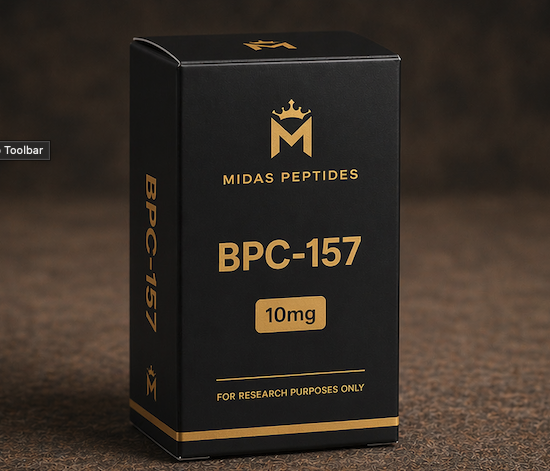
BPC-157 10mg
Body-protection compound
Widely studied in research for tissue-repair, angiogenesis and gut-lining pathways.
Verified Batch — Third-Party COA
Every lot of BPC-157 10mg is analyzed by an independent laboratory before it ships: purity by HPLC against the ≥99% specification, identity by mass spectrometry, matched to the lot number printed on your vial.
Loading batch data…
Research Summary
BPC-157 is a synthetic pentadecapeptide — a fifteen–amino‑acid sequence derived from a fragment of body protection compound, a protein originally identified in human gastric juice. Unlike many peptides of comparable size, it has been reported as unusually stable in acidic conditions, which is one reason it appears so often in oral‑administration animal models rather than injection‑only study designs.
Midas supplies it lyophilized at 10mg per vial. The third‑party Certificate of Analysis for your specific lot is published in the COA Library — verify purity and identity before you begin.
What the Research Examines
Published work on BPC-157 clusters around a small number of pathways:
- Tendon and ligament fibroblasts — cell migration, adhesion and survival in culture
- Angiogenesis — vascular formation models, including work examining VEGFR2 signalling
- Gastrointestinal mucosal integrity — the context in which the parent sequence was first characterised
- Nitric oxide system interaction — studied as a possible shared mediator across the above
An honest note on the evidence base: the overwhelming majority of this literature is preclinical — rodent models and in‑vitro cell work. Human clinical trial data is limited. A well‑designed protocol should account for that gap rather than assume it translates. We would rather tell you that than sell past it.
Handling & Reconstitution
Supplied as a lyophilized powder, sealed under vacuum. Standard laboratory practice:
- Allow the vial to reach room temperature before opening — cold glass draws condensation into the powder
- Reconstitute with bacteriostatic water, directing the stream against the vial wall rather than onto the powder itself
- Swirl gently until dissolved. Do not shake — mechanical agitation can disrupt peptide structure
- Store the lyophilized vial at −20°C for long‑term stability; refrigerate reconstituted solution and protect it from light
- Reconstituted peptide has a materially shorter working life than sealed lyophilized powder — plan volumes accordingly
Verifying This Lot
Every production lot is assayed by an independent laboratory before it ships. The COA for your lot reports HPLC purity against the ≥99% specification, molecular identity confirmed by mass spectrometry against the reference standard, and the lot number printed on your vial.
Match that number in the COA Library. If the document doesn't match what's in your hand, that is precisely why we publish them. New to reading these? Start with how to read a peptide COA, or the wider recovery compound overview.
Common Questions
- How does this differ from the BPC-157 / TB-500 mix? The blend combines two separate sequences studied in overlapping tissue‑repair models. This listing is single‑compound BPC-157, which is the appropriate choice when a protocol needs one variable rather than two.
- Why is it supplied lyophilized rather than pre‑mixed? Freeze‑dried peptide is stable for far longer than peptide in solution. Shipping it dry means the clock on degradation starts when you reconstitute it, not when it leaves our facility.
- Is there human clinical data? Limited. The published body of work is predominantly preclinical. We state this plainly rather than implying an evidence base that doesn't exist.
- What does ≥99% purity actually mean here? It is an HPLC measurement of how much of the material is the target sequence versus related impurities and residual synthesis by‑products — reported per lot, not as a blanket brand claim.
Documentation
- ≥99% verified purity, confirmed by HPLC on every production lot
- Molecular identity confirmed by mass spectrometry
- Batch/lot number maps to a downloadable COA in our COA Library
- Lyophilized; store per compound guidance included with your order
The Golden Standard Guarantee
If your order arrives damaged, incorrect, or with a sealed product that does not match its third-party COA, we replace it or refund it. No runaround.
- Ships fast: orders before 2:00 PM PT ship same business day, tracked, in plain unbranded packaging
- Cold-chain aware: insulated packaging with cold packs where the compound calls for it
- Free shipping on orders over $150 · $12 flat under
- 14-day window for damage, error, or COA-mismatch claims — email support@midaspeptides.com with your order number and a photo
Researcher reviews
Subscribe & Save — 15% off every recurring order
Lock in 15% off, free shipping, and a fresh lot-matched COA on your schedule — every 30, 45, or 60 days. Skip, swap, or cancel anytime by replying to any confirmation email. No fees, no lock-in.
Recurring orders are confirmed by email before each dispatch; you approve each one. Sold for laboratory research use only.
About BPC-157 10mg
BPC-157 is a synthetic pentadecapeptide — a fifteen amino-acid sequence derived from a protein found in gastric juice. It is one of the most extensively studied peptides in tissue-repair research.
Laboratory research has examined BPC-157 in models of tendon and ligament repair, angiogenesis (the formation of new blood vessels), and gastrointestinal lining integrity. Its stability in gastric conditions is one reason it appears so frequently in published repair-model literature.
Why researchers choose Midas
Every lot of BPC-157 10mg is independently tested by an accredited third-party laboratory for identity (mass spectrometry) and purity (HPLC), and the Certificate of Analysis for your exact batch is published in our COA library — not available "on request." Learn how to read a COA before you buy from anyone.
Ships cold-chain from the US in plain, unbranded packaging with tracking. Free shipping over $150.