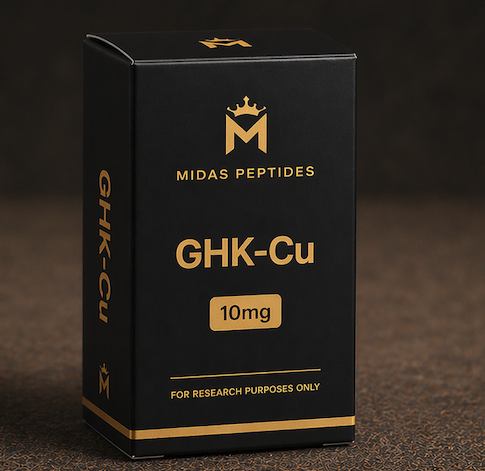
GHK-Cu 100mg
Copper-binding peptide
Researched for collagen synthesis, wound-healing signalling and skin-remodelling pathways.
Verified Batch — Third-Party COA
Every lot of GHK-Cu 100mg is analyzed by an independent laboratory before it ships: purity by HPLC against the ≥99% specification, identity by mass spectrometry, matched to the lot number printed on your vial.
Loading batch data…
Research Summary
GHK-Cu is a copper‑binding tripeptide — glycyl‑L‑histidyl‑L‑lysine, coordinated to a copper(II) ion. It is not a purely synthetic construct: the GHK sequence occurs naturally in human plasma, and a well‑cited line of research reports that circulating levels decline substantially with age. That observation is what turned a plasma peptide into one of the most studied molecules in skin and matrix research.
Midas supplies it lyophilized at 100mg per vial, with the third‑party Certificate of Analysis for your lot published in the COA Library.
What the Research Examines
The literature on GHK-Cu is unusually broad for a tripeptide, and concentrates on:
- Collagen and glycosaminoglycan synthesis — fibroblast culture studies examining extracellular matrix production
- Wound‑healing models — the largest single body of published work on the compound
- Copper transport — the peptide's affinity for Cu(II) is central to most proposed mechanisms rather than incidental to them
- Gene‑expression profiling — studies examining broad transcriptional signatures rather than a single receptor target
- Antioxidant and inflammatory signalling — examined in both dermal and systemic models
Much of the applied research sits in topical and cosmetic‑science contexts, which is worth knowing when designing a protocol — the delivery route in the source literature may not match yours.
Handling & Reconstitution
GHK-Cu behaves differently from most peptides in this catalogue, and the differences matter:
- The powder is blue. That colour comes from copper coordination and is expected — a white or colourless GHK-Cu powder is a reason to check your COA, not a cosmetic variation
- It is light sensitive. Keep the vial in its packaging and protect reconstituted solution from light exposure
- Reconstitute with bacteriostatic water against the vial wall; swirl, never shake
- Store lyophilized at −20°C; refrigerate after reconstitution
- Avoid contact with strong chelating agents, which can strip the copper from the complex and leave you researching plain GHK
Verifying This Lot
Copper peptides are a place where verification genuinely matters: an assay confirming the peptide sequence alone does not confirm that the copper complex formed correctly. Your lot COA reports HPLC purity against the ≥99% specification and molecular identity by mass spectrometry against the reference standard.
Match your vial's lot number in the COA Library. If you want to understand what each section of that document is telling you, read how to read a peptide COA — or what "research grade" actually means before you compare vendors on price.
Common Questions
- Why is the powder blue? Copper(II) coordination. It is the expected appearance for a correctly formed GHK-Cu complex, and one of the few peptides where colour is a useful first‑pass sanity check.
- Why 100mg rather than a smaller vial? GHK-Cu is typically studied at higher working concentrations than the injectable peptides in this catalogue, and much of its literature is topical. The larger fill reflects that.
- Does it need different storage from other peptides here? Yes — light protection matters more for GHK-Cu than for most. Otherwise the cold‑storage guidance is the same.
- Is it the same as "copper peptide" in skincare? Copper tripeptide‑1 is the cosmetic‑ingredient designation for the same molecule, though formulation concentration and carrier differ enormously between a finished cosmetic product and a lyophilized research compound.
Documentation
- ≥99% verified purity, confirmed by HPLC on every production lot
- Molecular identity confirmed by mass spectrometry
- Batch/lot number maps to a downloadable COA in our COA Library
- Lyophilized; store per compound guidance included with your order
The Golden Standard Guarantee
If your order arrives damaged, incorrect, or with a sealed product that does not match its third-party COA, we replace it or refund it. No runaround.
- Ships fast: orders before 2:00 PM PT ship same business day, tracked, in plain unbranded packaging
- Cold-chain aware: insulated packaging with cold packs where the compound calls for it
- Free shipping on orders over $150 · $12 flat under
- 14-day window for damage, error, or COA-mismatch claims — email support@midaspeptides.com with your order number and a photo
Researcher reviews
Subscribe & Save — 15% off every recurring order
Lock in 15% off, free shipping, and a fresh lot-matched COA on your schedule — every 30, 45, or 60 days. Skip, swap, or cancel anytime by replying to any confirmation email. No fees, no lock-in.
Recurring orders are confirmed by email before each dispatch; you approve each one. Sold for laboratory research use only.
About GHK-Cu 100mg
GHK-Cu is a naturally occurring copper-binding tripeptide (glycyl-L-histidyl-L-lysine) that your body produces, though levels decline substantially with age. It is among the most-researched peptides in skin and connective-tissue science.
Published research has investigated GHK-Cu for collagen synthesis signalling, dermal remodelling, antioxidant activity, and wound-repair pathways. Its copper-carrying property is central to much of this work, as copper is a cofactor in several enzymes involved in tissue structure.
Why researchers choose Midas
Every lot of GHK-Cu 100mg is independently tested by an accredited third-party laboratory for identity (mass spectrometry) and purity (HPLC), and the Certificate of Analysis for your exact batch is published in our COA library — not available "on request." Learn how to read a COA before you buy from anyone.
Ships cold-chain from the US in plain, unbranded packaging with tracking. Free shipping over $150.